You ran the diagnostic. You found a pattern. And now, before you decide what to do about it, there is a question worth sitting with.
Not what the data says. The data is what it is. But the interpretation – which signals you weighted, what you decided mattered most, which problems you named first – that passed through you. Your current state. Your current pressures. Your current relationship to the organization you were examining.
Was the read accurate?
This is not a character distinction. It is a measurement problem.
Why Does a Leader’s Internal State Affect Organizational Diagnosis?
Under sustained pressure, leaders see less – not less data, but less of it registers as meaningful, and what does register gets weighted differently.
The tendency, when reactive, is to filter toward information that confirms what you already suspect. Ambiguous behavior reads as resistance rather than confusion. Patterns that have been building for months get under-weighted because the most recent, most visible problem has claimed all the diagnostic bandwidth. Systemic conditions get attributed to individual performance because individual performance is more legible and more immediately actionable than a structural cause.
None of this is deliberate. It is how cognition works under pressure. The problem is not that the leader is unreliable. It is that the diagnostic process has not accounted for what the person running it is bringing into the room.
What Happens When a Leader’s Diagnostic Lens Is Distorted?
Here is what this looks like in practice.
A senior leader, three months into a restructure, commissions a team effectiveness review. Attrition has ticked up, a key project missed its timeline, and two high-performers have gone quiet in meetings. Something is off, and the data confirms it.
She reviews the findings carefully and reaches a conclusion: there is a communication problem. She designs an intervention around it.
The communication problem is real. But the data also shows something she does not weight as heavily – a decision rights problem that predated the restructure and that the restructure has made significantly worse. The root cause is visible in the data. She does not see it. The pressure she is under has narrowed her range to the most recent signals, and the most recent signal was the communication breakdown.
Three months later, the communication has improved. The real problem has not.
This pattern is not rare in leaders who are technically excellent diagnosticians. They know the frameworks. They ask the right questions. They still exit with the second-order finding, because the first-order one would require a longer timeline, a harder conversation, or an acknowledgment that something they built is not working.
The process feels productive – busy, purposeful, forward-moving. That feeling is the problem.
The highest-pressure situations – restructures, post-acquisition integration, significant leadership transitions – are exactly when accurate organizational diagnostics matter most and exactly when the conditions for accurate diagnosis are worst. The urgency creates the need. The urgency also compromises the read.
How Does Individual Leadership Capacity Determine What You See?
Individual leadership capacity is not the soft counterpart to structural organizational work. It is the prior condition.
You cannot accurately diagnose what your organization is built to hold if the instrument running the diagnostic is out of calibration. The quality of the structural work that follows depends entirely on the accuracy of the read that precedes it.
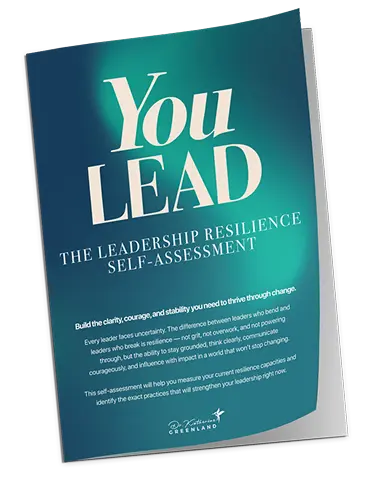
I designed the You LEAD self-assessment for this purpose: not as a wellness check or a personal development exercise, but as a pre-diagnostic calibration tool. The question it answers is structural – before you run a diagnostic on your organization, are you in a state to run it accurately?
The five pillars address the internal conditions that most reliably distort organizational observation when they are absent or unstable.
Grounded Presence and Self-Regulation. The regulatory foundation. A leader who cannot hold what they observe without their own reactivity filtering it will unconsciously edit the picture – amplifying what confirms their existing read, softening what requires more from them. The same symptom reads differently when you are regulated than when you are not.
Clarity in Transition. Leaders navigating significant personal or organizational change tend to interpret organizational signals through that lens. Unresolved transition in your own context shapes what you are prepared to see as possible, threatening, or worth addressing. This is a perceptual condition, not a mindset failure.
Values-Aligned Decision-Making. Are you interpreting what is true, or what you want to be true? Values misalignment does not just affect decisions downstream. It shapes the upstream process of determining which data is relevant in the first place.
Courageous Communication. A leader who struggles to name what they see will sometimes unconsciously avoid seeing it. The diagnostic and the conversation it requires are not separate steps. If you know the finding will demand a difficult conversation, that knowledge works backward into how you conduct the diagnostic itself.
Recovery and Sustainable Practice. Perceptual capacity is a function of physiological state. Chronically under-recovered leaders are operating with a narrower observational range than they recognize – and typically cannot see that narrowing from inside it.
What Should You Do Before Your Next Organizational Audit?
This is not an argument for waiting until conditions are perfect. That moment does not exist.
It is an argument for diagnostic transparency: knowing where your instrument is out of calibration, and factoring that into how you hold what you find.
Before your next team assessment, structural review, or leadership diagnostic – and especially before structural work following a restructure, a transition, or a sustained period of organizational pressure – take the You LEAD self-assessment first.
For each pillar that comes back low, ask one question: how might this condition be shaping what I am prepared to see – and what I may be steering around?
Then share the results with one trusted peer or advisor before you draw organizational conclusions. An external perspective on your current internal state is the simplest calibration check available to a senior leader. It does not require a lengthy process. It requires honesty about where you are before the work begins.
The organizational problem you are diagnosing may be exactly what you think it is. The most expensive mistakes in organizational design are not made by leaders who lacked information. They are made by leaders who were looking through a lens they did not know was distorted.
Frequently Asked Questions
What is individual leadership capacity and why does it matter for organizational change?
Individual leadership capacity refers to the internal conditions that determine how accurately a leader can read and act on organizational data – regulatory stability, values clarity, communicative courage, and sustainable practice. It matters because the leader is the primary instrument of organizational diagnosis and decision-making. A leader who is not operating from a calibrated internal state will interpret the same signals differently than a grounded one, producing different findings, different interventions, and different outcomes.
How does a leader’s internal state affect organizational diagnosis?
Under pressure, leaders filter toward information that confirms existing assumptions and away from data that adds complexity. Reactive leaders tend to attribute systemic problems to individual performance, over-weight recent signals, and reach structural conclusions faster than the evidence supports. The result is a diagnostic that feels confident but reflects the lens you were looking through as much as the state of the organization.
What is a leadership resilience self-assessment?
A leadership resilience self-assessment evaluates the internal conditions that support accurate organizational work under pressure. The You LEAD framework, developed by Dr. Katherine Greenland (Executive Coach, Leadership Strategist, and doctoral researcher in leadership resilience), assesses five pillars: Grounded Presence and Self-Regulation, Clarity in Transition, Values-Aligned Decision-Making, Courageous Communication, and Recovery and Sustainable Practice. It is designed as a structural calibration tool used before organizational auditing, not as a personal development or wellness exercise.
Why is diagnostic accuracy hardest to maintain during restructures and leadership transitions?
Because the conditions that most compromise diagnostic accuracy – sustained pressure, unresolved change, depleted capacity – are exactly the conditions that restructures and transitions create. The urgency that drives the need for an accurate organizational read is the same urgency that makes it harder to produce one. The higher the stakes, the more important calibration becomes, and the less likely it is to happen without deliberate effort.
What is the difference between a wellness check and a leadership diagnostic?
A wellness check evaluates how a leader is feeling. A leadership diagnostic evaluates how a leader’s internal conditions are affecting their operational capacity and the accuracy of their organizational observation. The You LEAD self-assessment is a diagnostic, not a wellness check. Its purpose is not personal support – it is to ensure that structural organizational work starts from an accurate read.